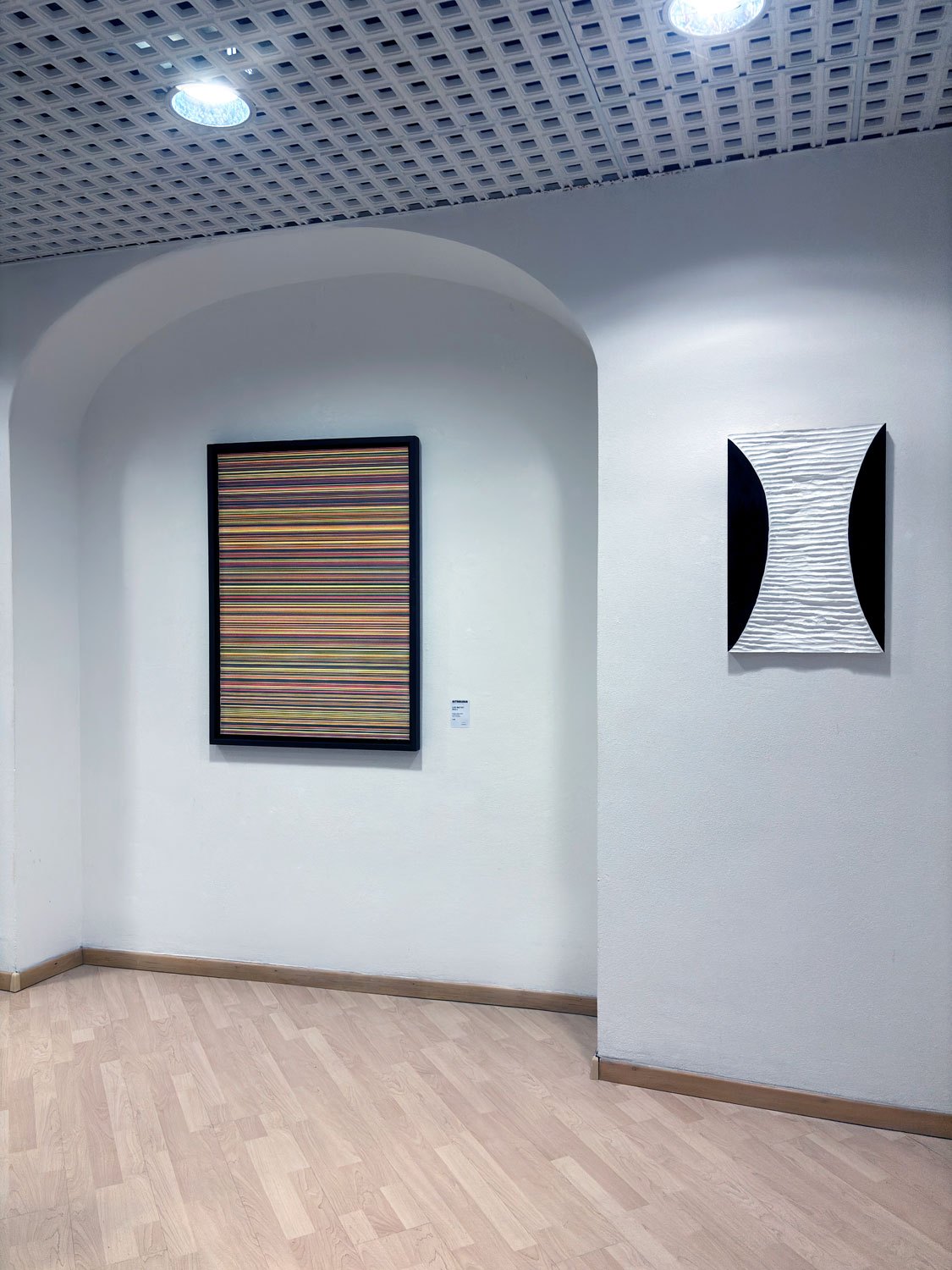
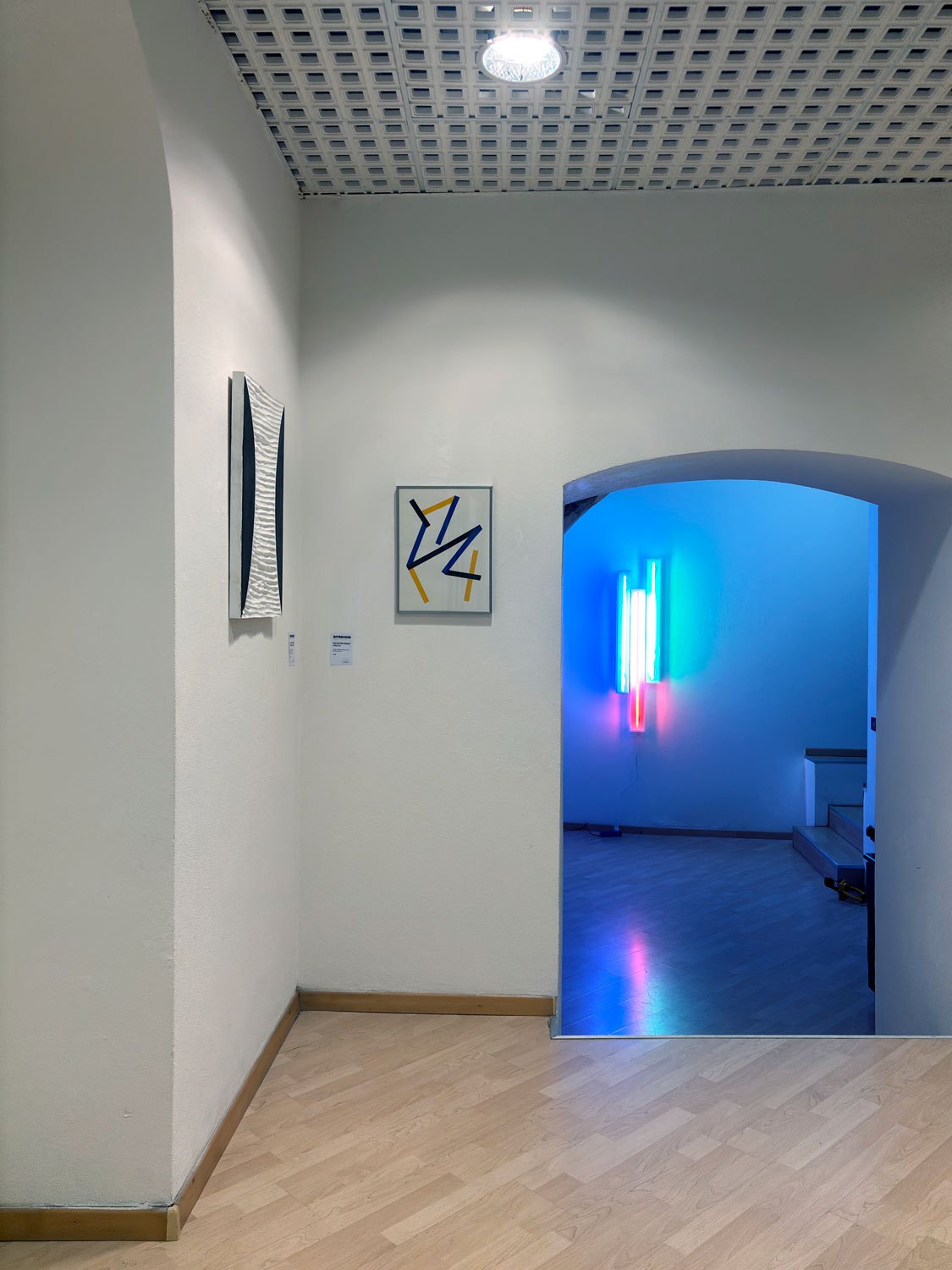
Altralinea, installation views, Galleria Contempo, 2026.
Exhibition Report
Altralinea, installation views, Galleria Contempo, 2026.
Thirteen Italian artists, one work each, and a single motif: the line. Altralinea, on view at Galleria Contempo in Pergine Valsugana near Trento in collaboration with Mazzacana Gallery, brings together painters and sculptors who present themselves less as a group show than as a movement.
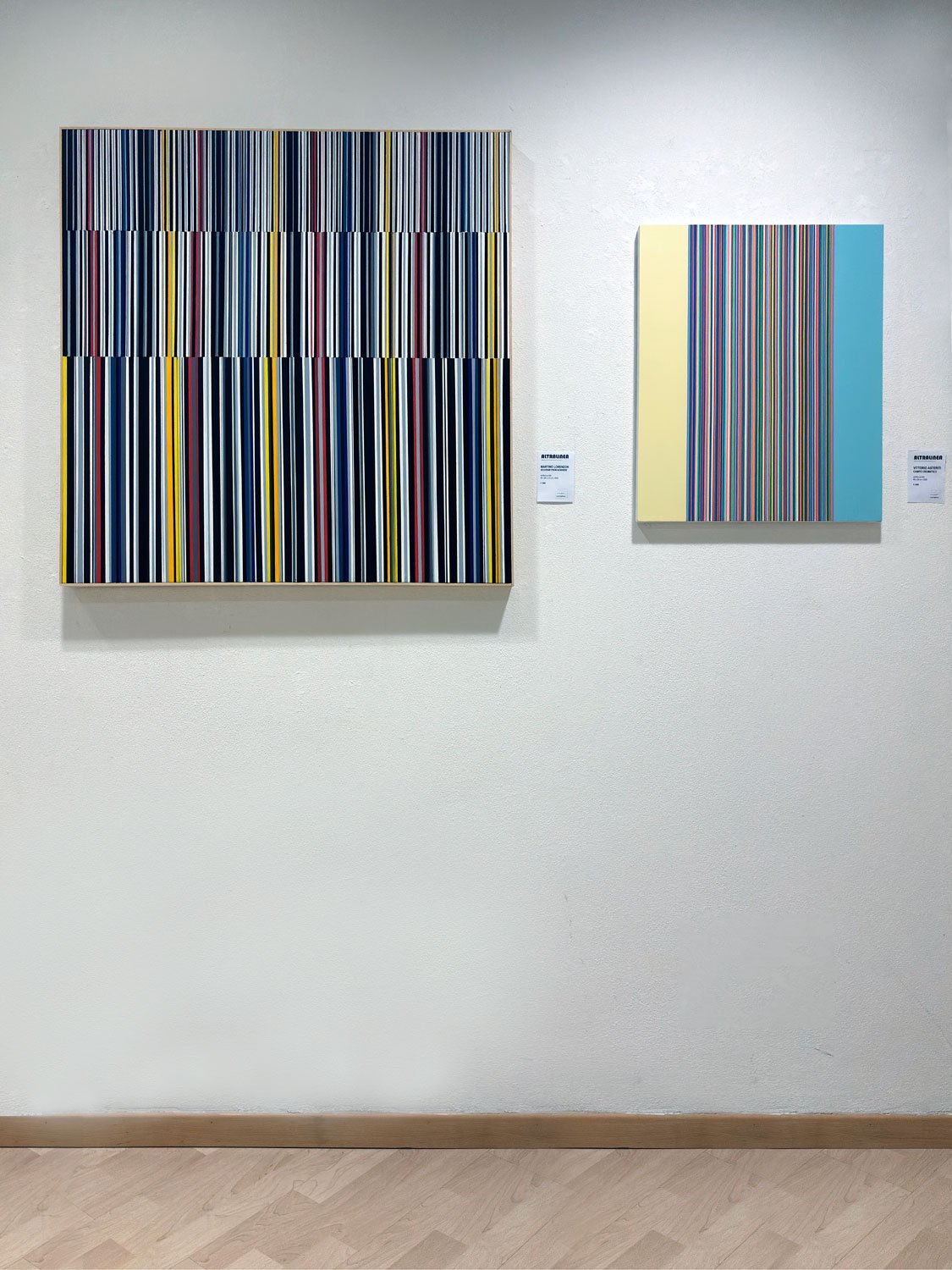
Among them is Vittorio Asteriti, one of the painters selected for Season II of Geometric Magazine. Below, with the kind permission of the gallery and the author, we publish a shortened English version of the exhibition text by Greta Alberta Tirloni, who led the project's scientific coordination.
From Mondrian's geometry to Futurism, Metaphysical art, Duchamp's readymades, Minimalism, Conceptualism and Italian Analytical Painting, contemporary art has increasingly asserted the autonomy of the artwork, placing concept and theory above pure form. The concept precedes the making, while meaning and the message take priority over visual display. This tendency also calls to mind the themes of Zen, simplification, emptiness, Japanese calligraphy and theatre, which have influenced and continue to influence art in the West.
All of these considerations can be found in the artists who work on and around the theme of the Line, showing how much creative breadth an apparently simple motif can yield. Their work also fills a void that seems to be missing from today's art world: coming together collectively as a movement, a group of artists, however varied, carrying out research around a shared axis, with each one mapping out their own territory within this field of inquiry. It is a de facto movement that now wants to come together publicly, with its shared principles, aims and manifesto.
This follows a rich tradition in Italy, from Futurism and the Via Cavour school to the gatherings of Piazza del Popolo in Rome, the All'Angelo restaurant in Venice and Bar Jamaica in Milan, up to Arte Povera, the Transavanguardia and, finally, Analytical Painting, to which the artists on show conceptually reconnect.
In La linea analitica dell'arte moderna (1975), the critic Filiberto Menna argued that modern art is in a state of increasing autonomy and ongoing questioning of its own language. Artists no longer use their work to represent external reality, but turn the work itself into a place of critical analysis of its own means of expression. Menna traced this path from Seurat's scientific breakdown of vision, through Malevich's Suprematism and Mondrian's Neoplasticism, which reduce reality to its logical and geometric skeleton, to Duchamp's readymade and the radical reductions of Ad Reinhardt. In Italy he found the same analytical line in artists such as Enzo Cacciola, Giorgio Griffa, Riccardo Guarneri, Pino Pinelli and Claudio Verna, who worked specifically with geometry and line. As Griffa liked to say: "I represent nothing, I paint."
The critic Luca Beatrice similarly describes contemporary art through the primacy of the mind over manual dexterity. The work becomes a code based on rules and reasoning, and it asks the viewer for thought rather than passive contemplation, turning the observer into an active participant.
The art of the Line represents this analytical and conceptual tradition and carries it forward. Its works recall Minimalism and Conceptualism: pure colour in paintings of stripes and lines, the colours and geometries of Mondrian, Richter's layered coats of paint. Broad or narrow vertical bands of rich colour appear side by side, and the viewer discovers that this colour is often the result of layering without preliminary drawing, so that the paintings become almost records of memory, preserving the time spent in their making. In making art a matter of art, they also call to mind Sol LeWitt and his lines of colour, and Daniel Buren, whose work is built on alternating stripes.
Shortened from the exhibition catalogue Altralinea (2026). English translation by Simon Turner. Published with the permission of the author and Mazzacana Gallery.
The artists and works
Tap any work to view it larger.
Images courtesy the artists and Mazzacana Gallery.
Visit the exhibition
Altralinea · Galleria Contempo
14 November – 11 December 2026
Via Tomaso Maier 48/A, 38057 Pergine Valsugana (Trento), Italy · in collaboration with Mazzacana Gallery
Subscribe for new Spotlights, exhibition reports and curated opportunities.
Subscribe →