Selected Artist
About
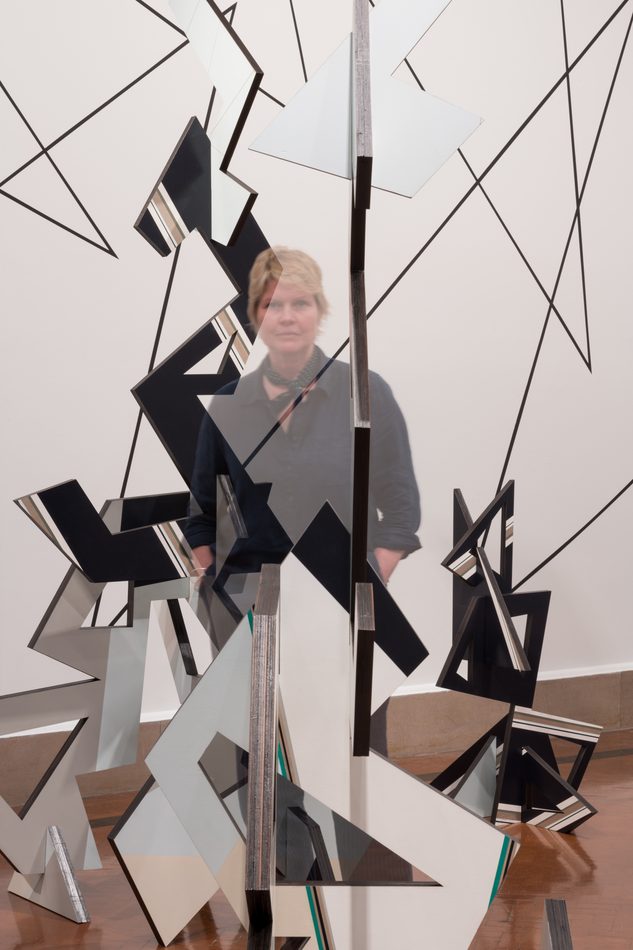
Lisa Traxler RWS, MRSS, LG (b. London, 1965) is a contemporary British artist based on England’s South Coast whose multidisciplinary practice spans painting and sculpture. Through an ongoing exploration of structure, geometry, colour and space, she investigates the potential of painting to extend beyond the confines of the picture plane and occupy physical, three-dimensional environments. Rooted in observation, her work develops through systems, grids and geometric frameworks that are subsequently disrupted by intuitive and material-led processes, generating dynamic relationships between form, surface and perception.
Drawing on a background in fashion, design and visual culture, Traxler creates works that move between two and three dimensions, examining the intersections of architecture, landscape, memory and the built environment. Her practice is characterised by a dialogue between precision and improvisation, where constructed forms become sites of visual enquiry.
Traxler is an elected member of the Royal Watercolour Society, the Royal Society of Sculptors and The London Group. She has received multiple Arts Council England awards and has exhibited extensively throughout the UK and internationally, including solo exhibitions at Southampton City Art Gallery, Pangolin London and The Foundry Gallery. Her work is held in public collections including Southampton City Art Gallery, the Royal Watercolour Society Diploma Collection, London, and the Fabriano Museum, Italy, as well as private collections throughout the UK, Europe, and the United States.
Selected works
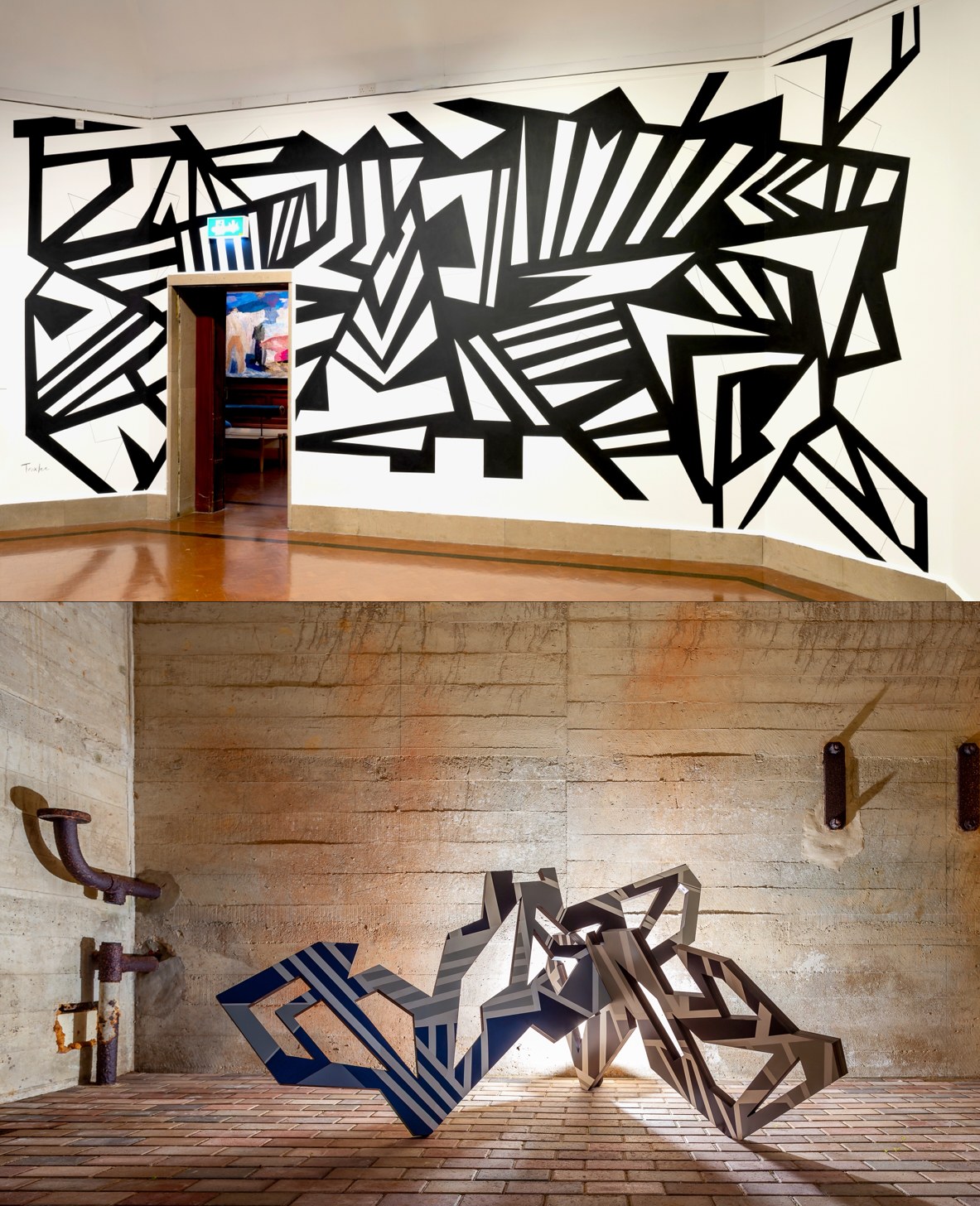
DAZZLE+DISRUPT, 2021, acrylic on plywood & emulsion wall mural
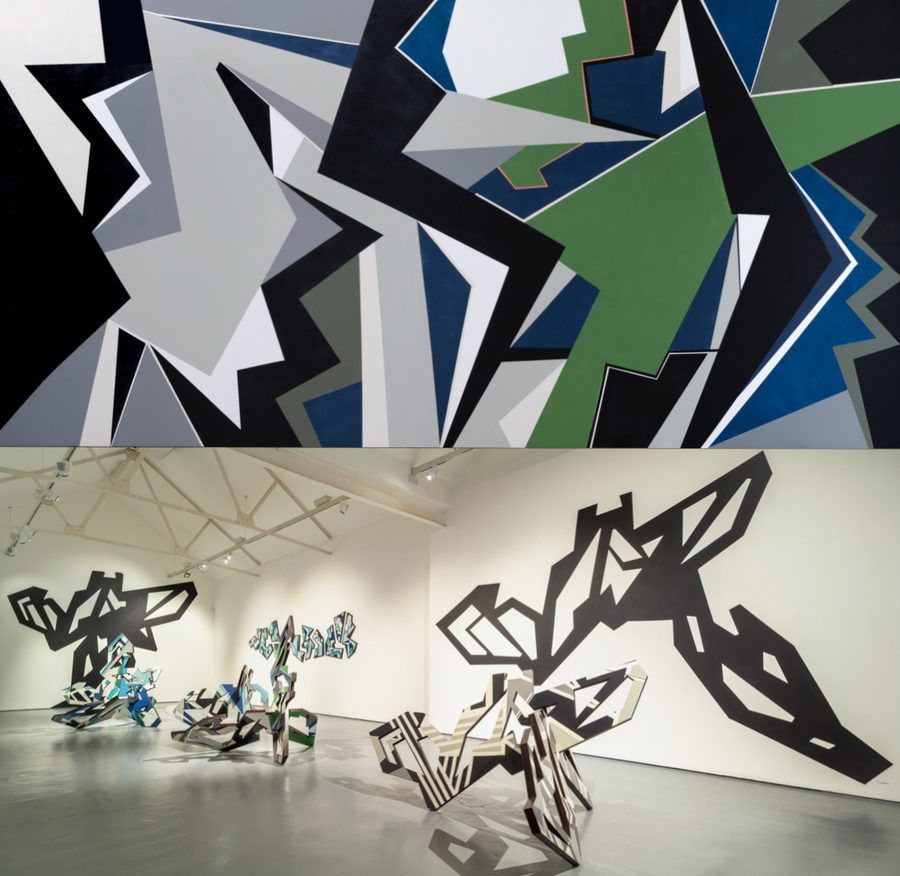
GHOST A/F, 2021, acrylic on poplar plywood, 122×244 cm
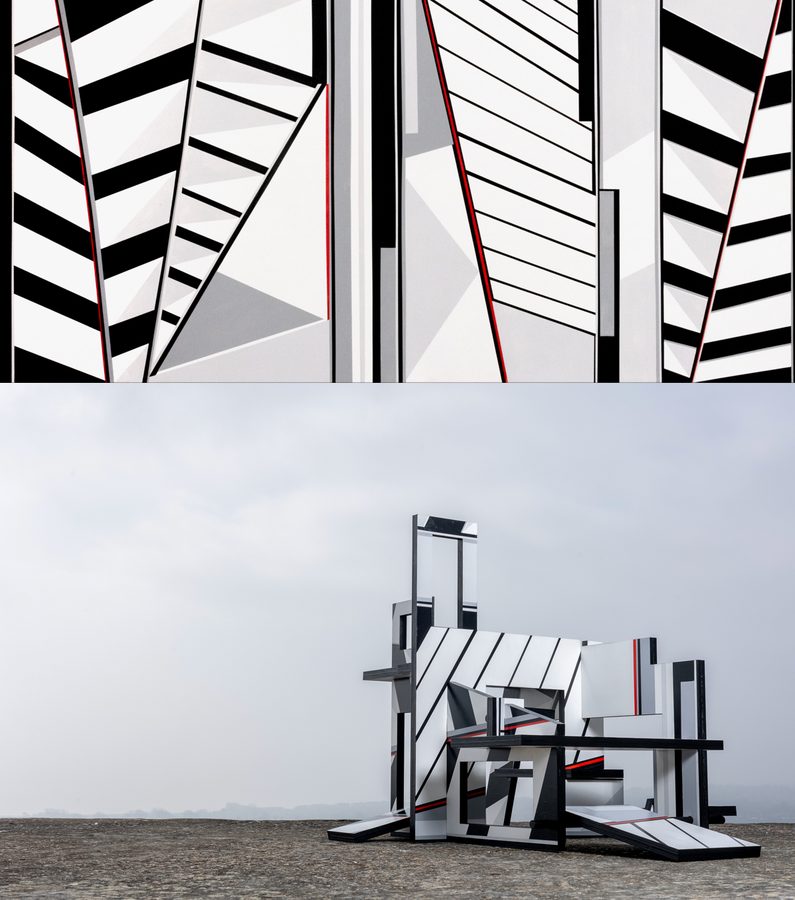
HIDING IN PLAIN SIGHT, 2025, acrylic on poplar plywood, 122×244 cm
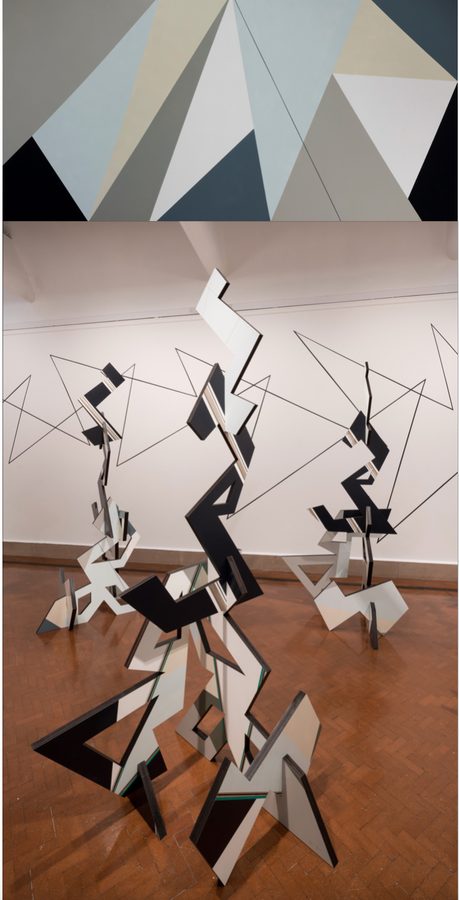
LAND FOLDED / SHAPE SHIFTERS, 2022, emulsion on wall & acrylic on plywood
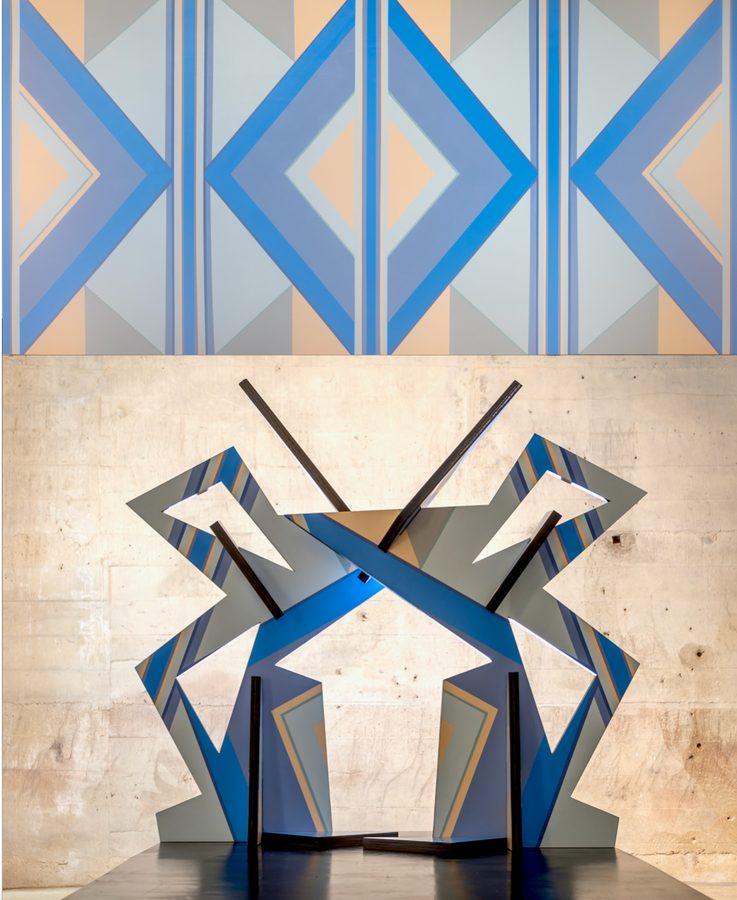
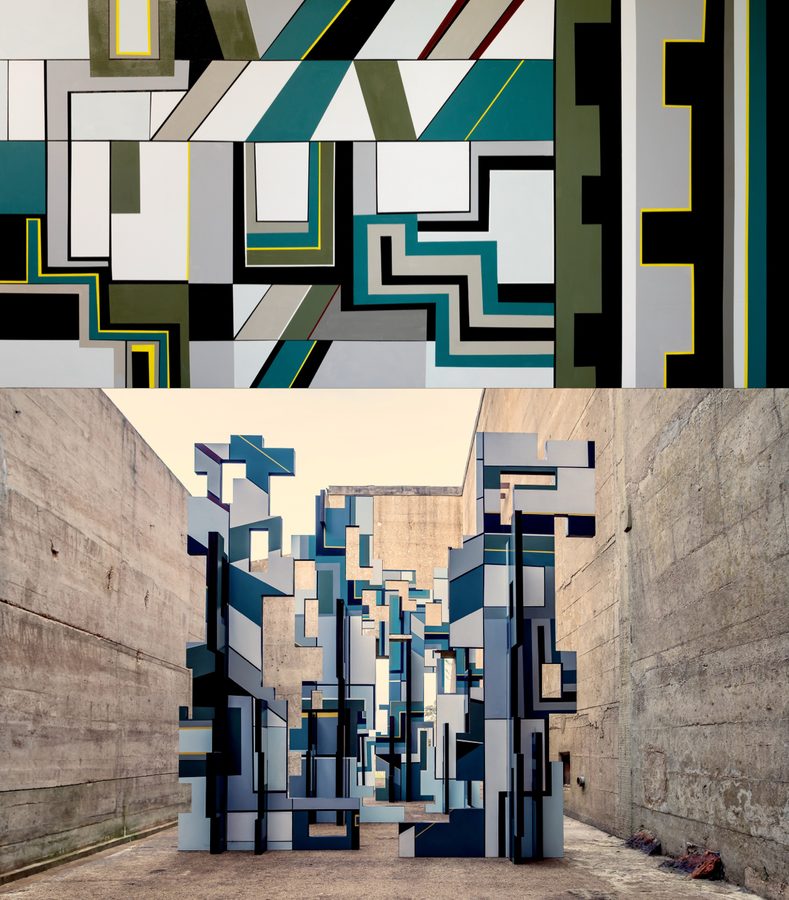
OUTER SPACE / STRANGE CARGO, 2023, acrylic on poplar plywood, 122×244 cm
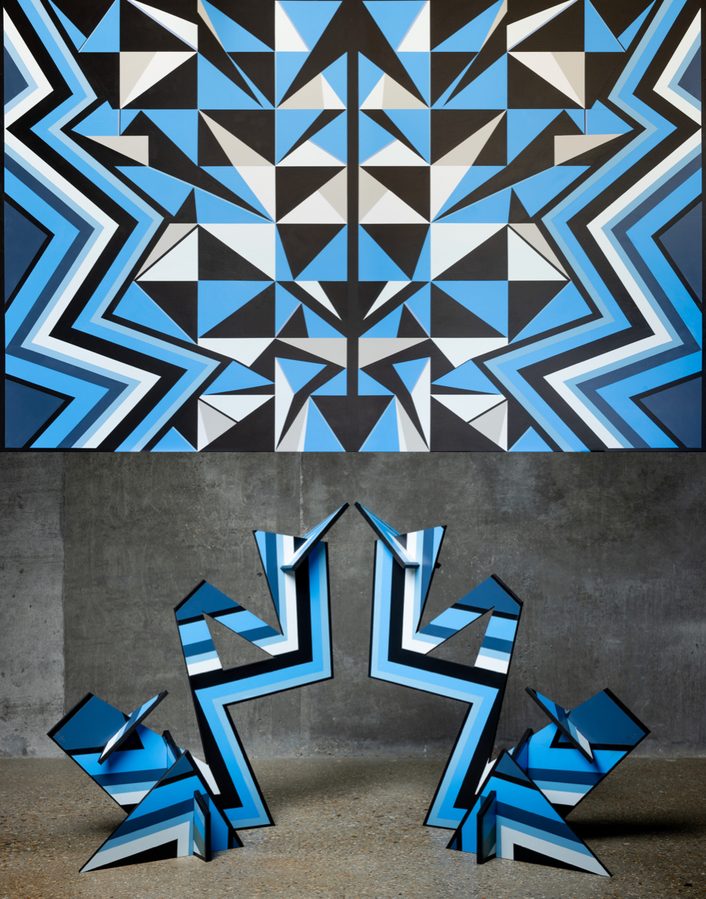
WAVE, 2024, acrylic on poplar plywood, 122×244 cm
Statement — Geometry as Lived Experience
“If those two colours sing together, if that shape pushes against the other shape and creates something…”
People often assume that my work begins with geometry. In fact, it begins much earlier than that. It begins with looking.
I’ve never thought of geometry as a system that I impose on the work. It’s simply the language through which I understand relationships — between colour and form, light and shadow, surface and space, painting and sculpture. It’s almost how my brain thinks.
I’ve always been drawn to abstraction because it allows those relationships to remain open. I’m not trying to tell a viewer what to see or how to look. Instead, I’m interested in creating a space where colour, shape and form can be experienced rather than explained. If two colours sing together, if one shape pushes against another and creates a sense of movement or tension, then something begins to happen. That’s what I’m searching for. It isn’t about recognising an object. It’s about recognising a feeling.
My work moves continually between painting and sculpture, between intuition and precision. Each sculpture begins as a painted surface. The early stages are instinctive and exploratory, but gradually the work enters another language: measurement, fabrication, and precision. I work with full sheets of painted plywood, developing forms that are eventually cut and assembled into sculptural structures. There is a moment when the painted surface ceases to be an image and begins to occupy space — allowing these flat-pack constructions to slot together and move between disassembly and assembly, the flatness of the painted plane into three-dimensional form. This puzzle-like process requires each component to perform a precise role, yet no single element is sufficient on its own. I never entirely know how a sculpture will resolve itself until all of its parts are fabricated and assembled. Only then do I discover if it has found its own internal balance — does it sing in its rebirth?
My early training in fashion, where flat pattern pieces were transformed into garments, continues to inform the way I think about construction, volume and spatial relationships. Architecture has also become central to my practice, not simply as an influence but as a way of living and observing. Building homes, living alongside architectural practice and observing how light behaves across materials have all become part of the way I see. A former Second World War radar bunker became a particularly important catalyst. Its weathered concrete, shifting shadows and powerful sense of presence led me to think differently about geometry — not as abstraction alone, but as something capable of holding time through memory, atmosphere and history.
Research is an integral part of my practice. Discovering First World War dazzle camouflage revealed another way that geometry could transform perception. I was fascinated by the audacity of those painted ships, where bold geometric forms were used not to decorate but to disrupt understanding. That idea, that geometry can alter the way we perceive space, movement and form, continues to resonate throughout my work.
People often describe my sculptures as simple. I understand why. Their forms appear economical. What remains unseen are the months of research, maquette making, painting, sanding, measuring, fabrication and refinement that allow each work to arrive at that simplicity. I’m interested in distilling complexity rather than displaying it.
One question I was asked while preparing this profile was whether I work with rules. The more I thought about it, the more I realised that I don’t. I think instead in terms of chapters. Each body of work grows from the last, carrying certain ideas forward while opening new questions. That feels much closer to the reality of my practice than following a fixed set of rules.
Looking back over recent years, I can see that periods of intense making have been followed by periods of transition and reflection. Rather than seeing those quieter moments as interruptions, I’ve come to understand them as essential to the work itself. They create the space in which new ideas begin to emerge.
Ultimately, my work isn’t trying to explain geometry. It uses geometry to understand relationships — between materials, histories, colours, forms and ways of seeing. If the work invites someone to look and to discover those relationships for themselves, then I feel it has done what I hoped it might do.
Geometry is a lived experience for me — through architecture, landscape, fabric, memory, history, light and the physical act of making and assembling.
Lisa Traxler, July 2026
Newsletter
Curated open calls and one artist to know, every couple of weeks. Free, no spam.